What You Need to Know About the Western Blue Line
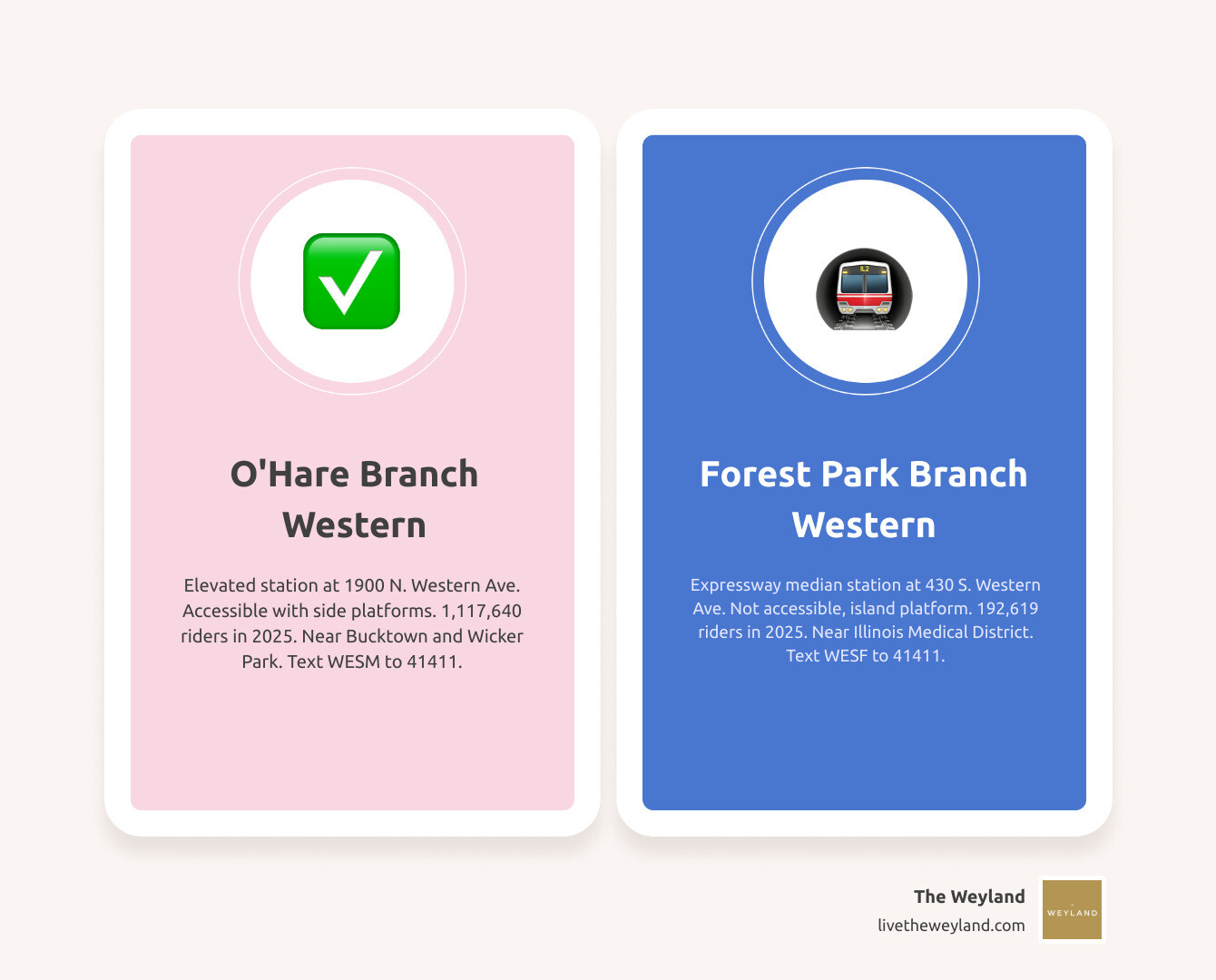
The western blue line is actually two separate CTA stations — not one. Both share the name "Western," but they sit miles apart on different branches of the same line.
Here's a quick breakdown:
| Western (O'Hare Branch) | Western (Forest Park Branch) | |
|---|---|---|
| Address | 1900 N. Western Ave., Chicago, IL 60647 | 430 S. Western Ave., Chicago, IL 60612 |
| Structure | Elevated station | Expressway median station |
| Accessible? | Yes | No |
| Key Neighborhood | Bucktown / Wicker Park | Illinois Medical District |
| 2025 Ridership | 1,117,640 | 192,619 |
| Text for Arrivals | CTATRAIN WESM to 41411 | CTATRAIN WESF to 41411 |
The O'Hare branch station is the busier of the two — and the one most riders near Wicker Park and Bucktown use. The Forest Park branch station sits in the median of the Eisenhower Expressway on the city's Near West Side.
Both stations are served by the same Blue Line, which runs 24 hours a day, every day between O'Hare International Airport and the Forest Park terminal. At 26.93 miles, it's the longest line on the Chicago 'L' system.
Whether you're commuting downtown, heading to the airport, or simply exploring what it's like to live steps from rapid transit, knowing which Western station you need makes all the difference.
I'm Gunnar Blakeway-Walen, Marketing Manager at FLATS®, and my work connecting Chicago residents to vibrant, transit-accessible neighborhoods — including those served by the western blue line — gives me a ground-level perspective on what riders and renters really need to know. Let's dig into everything that makes these two stations tick.
Understanding the Two Western Blue Line Stations
If you search "Western Blue Line," CTA will not ask, "Do you mean the elevated one by Bucktown or the one in the Eisenhower?" It probably should.
Chicago's Blue Line is unusual because it has duplicate station names. Western is one of them, and that creates real confusion for riders, visitors, delivery drivers, and the occasional friend who texts "I'm at Western" as if that solves everything.
Here is the simplest side-by-side view:
| Feature | Western (O'Hare Branch) | Western (Forest Park Branch) |
|---|---|---|
| CTA station code for text arrivals | WESM | WESF |
| Address | 1900 N. Western Ave., Chicago, IL 60647 | 430 S. Western Ave., Chicago, IL 60612 |
| Part of line | O'Hare branch | Forest Park branch |
| General area | Bucktown / Wicker Park / Logan Square edge | Near West Side / Illinois Medical District area |
| Station type | Elevated | Expressway median |
| Platform layout | Two side platforms | One island platform |
| Accessibility | Accessible | Not accessible |
| Bus connections | #49, #X49, #56, #73 | #7, #49, #X49 |
For most people living in or visiting Wicker Park, Bucktown, or nearby Logan Square, the station they mean is Western on the O'Hare branch.
Western Blue Line on the O'Hare Branch
This is the Western station most relevant to daily life around Wicker Park and Bucktown. It sits at 1900 N. Western Ave. and serves the Milwaukee corridor side of the Blue Line.
The station is elevated, accessible, and designed with two side platforms. CTA lists sheltered bike parking here, which is a real plus for riders combining cycling and transit instead of playing the classic Chicago game called "Can I lock my bike somewhere reasonable?"
It also has strong bus connectivity:
- #49 Western
- #X49 Western Express
- #56 Milwaukee
- #73 Armitage
That mix matters. Western Avenue gives you a straight north-south spine, Milwaukee reaches deeply into the Northwest Side and downtown, and Armitage helps with east-west connections. For residents who want easy access to the surrounding neighborhoods, this stop works especially well for Bucktown, Wicker Park, and the edge of Logan Square.
CTA's official station page confirms the station is accessible and provides arrivals, alerts, and connections: Western (Blue Line Station-O'Hare Branch) Station Information - CTA.

Western Blue Line on the Forest Park Branch
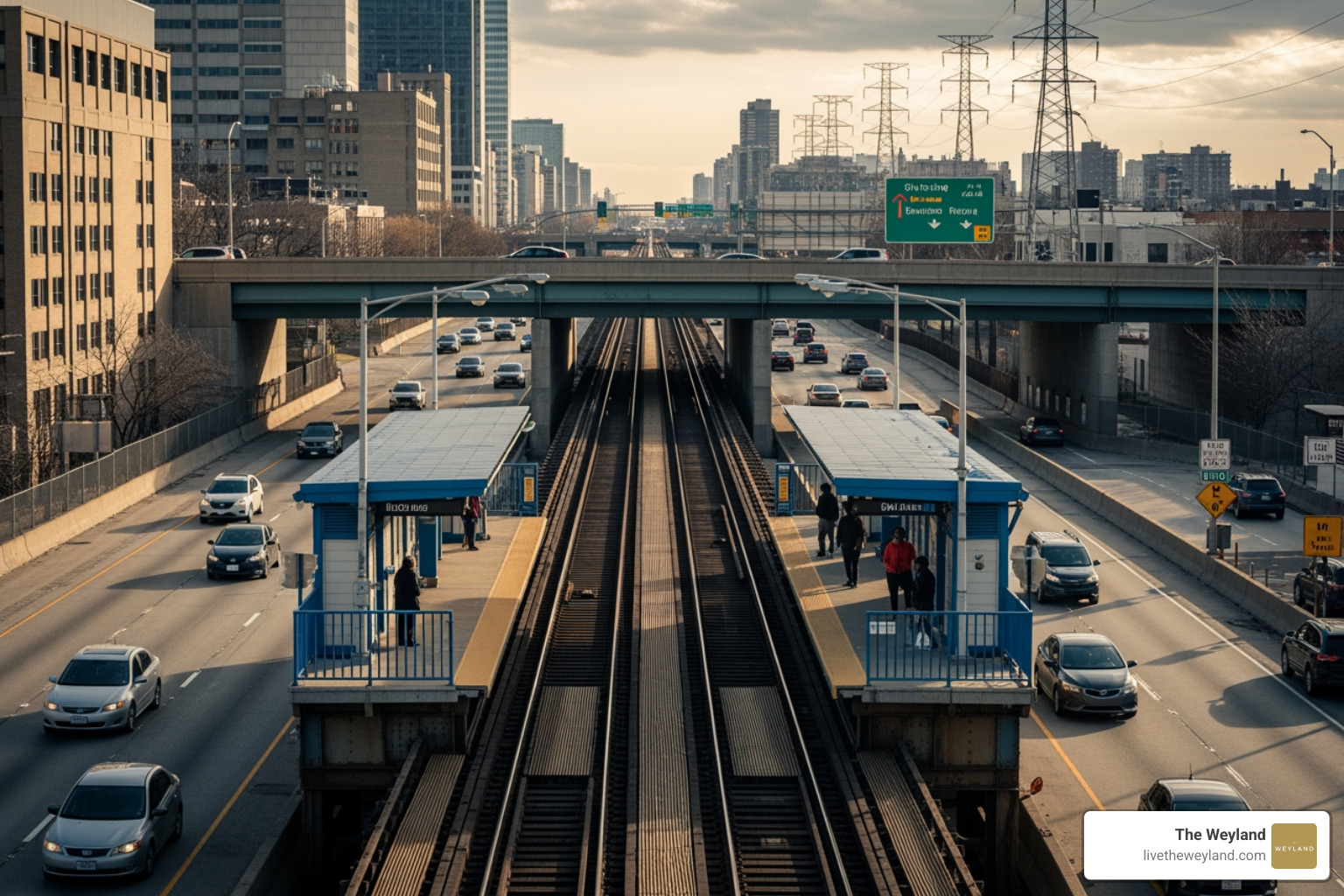
The other Western is very different. Located at 430 S. Western Ave., this station sits in the median of the Eisenhower Expressway on the Forest Park branch.
Instead of an elevated structure in a neighborhood shopping corridor, this station is an expressway-median station with one island platform between two tracks. It serves the Near West Side and offers access toward the Illinois Medical District area. It is also about a mile north of the nearby Metra station on Western.
CTA bus links here are:
- #7 Harrison
- #49 Western
- #X49 Western Express
Unlike the O'Hare branch station, this one is not accessible. That is one of the biggest practical differences between the two Western stops and an important one for trip planning.
The setting also feels completely different. The O'Hare branch station is woven into neighborhood life; the Forest Park branch station feels much more like infrastructure inside infrastructure, nested in the middle of a major expressway corridor.
History of Western Blue Line and How Service Evolved
To understand the western blue line, we have to go back before it was called the Blue Line at all.
Chicago's rapid transit system evolved through private companies, route mergers, subway construction, expressway projects, CTA takeover, and later color-based naming. What we now call the Blue Line draws from older pieces of the Metropolitan West Side Elevated and later the Congress and Milwaukee-Dearborn routes. The current line name "Blue Line" was adopted in 1992, but the tracks and stations are much older.
A helpful broad overview is available in Blue Line (CTA)).
O'Hare Branch History at Western
Western on the O'Hare branch opened on May 25, 1895, making it one of the older stations on today's Blue Line. It began as part of the Metropolitan West Side Elevated Railroad's Logan Square branch.
Over time, this station changed with the system:
- It was rebuilt in 1930.
- It was reconstructed again in 2000-2001.
- The reconstruction preserved historic character while modernizing the station for contemporary service.
One of the best-known architectural details is the Art Deco station house with tan terra cotta. During the 2000-2001 work, CTA updated the platforms and made the station accessible while keeping key historic design elements. That balance between old Chicago and working Chicago is part of what makes this station memorable.
Operationally, the route itself evolved too. What started as the Logan Square branch later became part of the Milwaukee route and eventually the O'Hare branch after northwest extensions, including the 1984 extension to O'Hare Airport. So while the station stayed in place, the line around it kept expanding in importance.
Historically, this station was also designated a "B" station during skip-stop operations. More on that in a minute, because yes, Chicago once made riders memorize letters just to catch a train efficiently.
For station-specific history, see Western station (CTA Blue Line O'Hare branch)).
Forest Park Branch History at Western
Western on the Forest Park branch has a different story. An earlier elevated Western station in this corridor operated from the late 19th century era but closed in 1953. The current station did not open until June 22, 1958.
Why the gap and relocation? Expressway construction.
The Congress branch, which later became part of today's Forest Park branch, was rebuilt in conjunction with the Eisenhower Expressway project. Instead of restoring the old elevated setup, planners placed the rail line in the expressway median. That is why the current station feels so different from the O'Hare branch Western: it was designed as part of a mid-century transportation corridor, not as a traditional neighborhood "L" stop.
Historically, this station served as an "A" stop under skip-stop service. Its island platform and median layout reflect the practical, car-era design logic of the 1950s.
How Skip-Stop, Extensions, and Slow Zones Changed Service
The Blue Line's service pattern has changed a lot over the decades.
In 1951, CTA introduced skip-stop service on parts of the system. Stations were assigned "A," "B," or "AB" designations:
- A trains stopped at A and AB stations
- B trains stopped at B and AB stations
At Western, that meant the two stations were treated differently:
- O'Hare branch Western was historically a B station
- Forest Park branch Western was historically an A station
Skip-stop sped up some trips, but it also made service less intuitive. Riders had to know not just their stop, but which letter pattern was operating. CTA later simplified service, and over time the system moved away from that structure.
Another major change came in 1992, when CTA adopted color names for routes. That is when the West-Northwest Route became today's Blue Line.
The line's expansion toward O'Hare dramatically increased the importance of the O'Hare branch Western station. It became part of a direct, 24/7 corridor linking Northwest Side neighborhoods, downtown, and the airport.
The Forest Park branch has faced a different challenge in recent years: infrastructure wear. According to the broader Blue Line reference material, slow zones on the Forest Park branch rose sharply from 13.1% in 2016 to 84.4% in 2026. Deferred maintenance, drainage issues, and track deterioration have all contributed. The result has been slower travel and longer end-to-end trip times, with travel times increasing roughly 10 minutes between 2014 and 2024 on affected sections.
So when people ask how service evolved at Western, the answer is: through route mergers, line extensions, naming changes, expressway reconstruction, skip-stop operations, and now a modern era of repair needs.
Connections, Amenities, and Neighborhood Access at Western Blue Line
For most riders, station history is interesting. But what we really need on a Tuesday morning is this: How do we get where we are going, and how annoying will it be?
That is where the two Western stations separate even more clearly.
Bus, Bike, and Arrival Tools
The O'Hare branch Western station is better equipped for multimodal commuting:
- Accessible station design
- Sheltered bike parking
- Four CTA bus connections: #49, #X49, #56, #73
The Forest Park branch station is more limited:
- No accessibility
- Fewer direct bus connections: #7, #49, #X49
For real-time planning, CTA offers several useful tools for both stations:
- Text CTATRAIN WESM to 41411 for O'Hare branch Western arrivals
- Text CTATRAIN WESF to 41411 for Forest Park branch Western arrivals
- Use CTA Train Tracker on the station pages
- Check route-wide alerts on the Blue Line (Route info, alerts & schedules) - CTA
CTA also notes live video feed availability for some Blue Line stations and corridors on weekdays, which can help with commute timing.
A few practical tips:
- If CTA says trains are boarding on the same track in both directions, slow down and confirm signage before stepping onto the platform.
- If you are heading to Wicker Park or Bucktown, double-check that you selected the O'Hare branch Western, not the Forest Park branch station.
- If accessibility is important for your trip, plan around the O'Hare branch station.
Nearby Neighborhoods, Landmarks, and Daily Use
For us, this is where the western blue line becomes more than a transit fact. It becomes part of everyday neighborhood life.
The O'Hare branch Western station is especially useful for:
- Bucktown
- Wicker Park
- The western edge of Wicker Park's dining and shopping corridors
- Parts of Logan Square
- Easy transfers toward downtown or O'Hare
If you're exploring the area or apartment hunting, our guides to Wicker Park Blue Line and Apartments Near Blue Line can help connect transit access with what living here actually feels like.
The Forest Park branch Western station serves a different use case:
- Near West Side trips
- Access toward the Illinois Medical District area
- Commuters moving along the Eisenhower corridor
- Bus transfers on Western and Harrison
In short:
- For neighborhood energy and daily life near Wicker Park, think O'Hare branch Western.
- For medical district access and Near West Side travel, think Forest Park branch Western.
Service Alerts, Planned Work, and What to Check Before You Ride
Blue Line service runs all day and all night, but "24 hours" does not mean "nothing unusual is happening." On CTA, overnight service can still come with planned work, boarding changes, or delays.
That matters at Western because both stations sit on a line that regularly undergoes maintenance and operational adjustments.
Current and Upcoming Alerts Affecting Western Riders
As of May 2026, CTA's Blue Line alerts have included planned work and delay notices affecting areas riders from Western commonly travel through.
Research indicates recent alerts have included:
- Boarding changes between Clark/Lake and Damen
- Planned work affecting service between Racine and Jackson
- Same-track operations during overnight or weekend work windows
- Minor delays tied to maintenance activity
CTA station research for Western also referenced multiple alert periods in March 2026 and route-wide alerts in May 2026. These types of notices usually do not mean Western itself is closed, but they can change how you board and how long your trip takes.
That is especially important if:
- You are traveling during weekends or late nights
- You are connecting through downtown
- You need precise timing for work, a flight, or an appointment
- You are using the Forest Park branch, where slow zones already affect running times
The best official station-specific source is Western (Blue Line Station-O'Hare Branch) Station Information - CTA, and route-wide information is on the Blue Line alerts page.
How to Check Real-Time Status Before Leaving
Our best advice is simple: check before you walk out the door.
Use this quick routine:
- Look at the Blue Line (Route info, alerts & schedules) - CTA page for route-wide alerts.
- Open the Western station page for the station you actually need.
- Text the station code for live arrival estimates:
- WESM for O'Hare branch Western
- WESF for Forest Park branch Western
- If there is planned work, read whether trains are using one track for both directions.
- Build in a few extra minutes if you are traveling across the Forest Park branch.
That tiny bit of prep can save a lot of platform confusion. Nothing says "character-building experience" quite like realizing you were calmly waiting on the wrong side while your train sailed past on the other track.
Ridership, Accessibility, and Which Western Station Fits Your Trip
The two Western stations do not just look different. They perform very differently too.
Ridership Trends at Both Western Stations
In 2025:
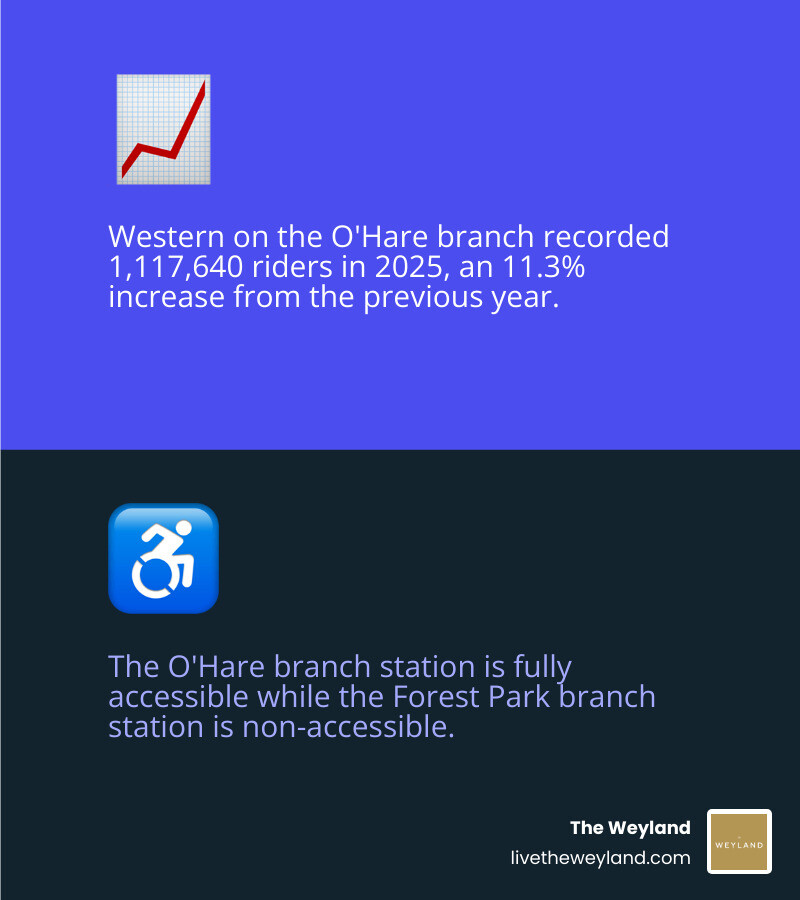
- Western on the O'Hare branch recorded 1,117,640 riders
- That was an 11.3% increase from the previous year
- Western on the Forest Park branch recorded 192,619 riders
- That was a 3.7% decrease from the previous year
That gap is massive. The O'Hare branch station handled well over five times as many riders as the Forest Park branch station.
Why?
A few reasons stand out:
- It serves denser residential and commercial areas near Bucktown and Wicker Park
- It has stronger neighborhood walk-up traffic
- It is accessible
- It offers more bus connections
- It sits on the airport branch, which has broader all-day demand
The Forest Park branch station, by contrast, serves a more infrastructure-heavy corridor with lower foot traffic and fewer surrounding neighborhood retail clusters right at the station entrance.
Accessibility and Rider Experience
Accessibility is one of the biggest decision points between the two stations.
Western on the O'Hare branch:
- Accessible
- Elevated station with updated facilities
- Sheltered bike parking
- Better suited for riders using mobility aids or strollers
- More convenient for neighborhood-based daily use
Western on the Forest Park branch:
- Not accessible
- Expressway median layout
- More limited station environment
- Better suited to riders already traveling that corridor who do not need elevator access
If transit access shapes where you want to live, this distinction matters a lot. Our pages on Apartments Near CTA and Blue Line Apartments explore why being close to an accessible, high-frequency Blue Line station can make daily Chicago life much easier.
For anyone choosing between the two:
- Pick O'Hare branch Western for Wicker Park, Bucktown, Logan Square edge, accessibility, and stronger daily convenience.
- Pick Forest Park branch Western for Near West Side or Illinois Medical District-oriented trips.
Frequently Asked Questions About Western Blue Line
Which Western Blue Line station is near Wicker Park?
Western on the O'Hare branch is the station near Wicker Park. It is located at 1900 N. Western Ave. in Bucktown, right by the Wicker Park area and close to the Milwaukee corridor.
Is Western Blue Line open 24 hours?
The Blue Line runs 24 hours a day, every day, and both Western stations are on that line. Service frequency varies by time of day, but overnight trains do continue to operate.
Which buses connect to each Western station?
Western on the O'Hare branch connects to:
- #49 Western
- #X49 Western Express
- #56 Milwaukee
- #73 Armitage
Western on the Forest Park branch connects to:
- #7 Harrison
- #49 Western
- #X49 Western Express
Conclusion
The most important thing to remember about the western blue line is that it is not one station but two.
The O'Hare branch Western is the one most people around Wicker Park, Bucktown, and nearby Logan Square mean. It is older, busier, accessible, and more deeply connected to neighborhood life. The Forest Park branch Western serves a different corridor entirely, with a median station layout, lower ridership, and a stronger connection to Near West Side travel.
If you ride often, the winning strategy is simple:
- Confirm which Western you need
- Check alerts before leaving
- Use the correct text code for arrivals
- Plan around accessibility and branch-specific conditions
For anyone who wants to live close to the transit, dining, and neighborhood energy that make this part of Chicago so appealing, being near the right Western stop can make everyday life much smoother. You can explore more in our guide to Blue Line Wicker Park.